



 France
 Bestseller
 All Printers
 All Labels
 Money Counters
 All Accessories
In 2026, the "unboxing experience" in the fast-paced e-commerce environment has evolved from a luxurious extra to a fundamental marketing necessity. Indeed, due to the dynamics of social media, more than 65% of customers would post a photo of their order online if the packaging appears personalized and high-quality. For small businesses and entrepreneurs, this essentially means that every package can serve as viral advertising space. A simple, attractively designed logo sticker has the power to transform a plain shipping box into a branded experience that not only wins customer trust but also leads to repeat purchases.
It is a known fact that small business owners often face the challenge of professional branding without having the budget of a large corporation. This guide closes that gap by showing you ways to design and print stickers that lead to professional and consistent results.
Why Your Brand Needs Custom Logo Stickers in 2026
Custom stickers are an extremely cost-effective way to connect your online shop with the physical world. They tactilely remind the customer of the quality and attention to detail of your brand.
Whether as a seal on tissue paper or as a decorative element on shipping bags, a logo sticker is a strong brand mark at the very moment the customer eagerly opens their package. In a highly competitive market, it's the small things that distinguish a "hobby seller" from a "professional brand." Besides aesthetics, stickers also support logistics by securing packaging or highlighting important information. For many business people, using custom labels is the first step towards a holistic brand identity system.
Generate Creative Design Ideas for Your Brand Stickers
The first step to creating a sticker that people will value and proudly display is to determine the visual direction that appeals to your target audience. Your design is a reflection of your brand's character and the core messages you want to convey.
When developing design concepts, consider the overall feeling your business should express. Is your brand a minimalist, natural skincare line or a colorful, energetic stationery store? If you need inspiration, MUNBYN offers a huge catalog with over 3,500 design elements and 2,000 templates. These resources allow you to experiment with different shapes, icons, and layouts without needing professional design software. You can freely combine various elements to create something unique that represents your story while looking professional.

The physical size of your sticker determines how much information you can include and where it can be placed. Choosing the right shape is just as important as the logo itself.
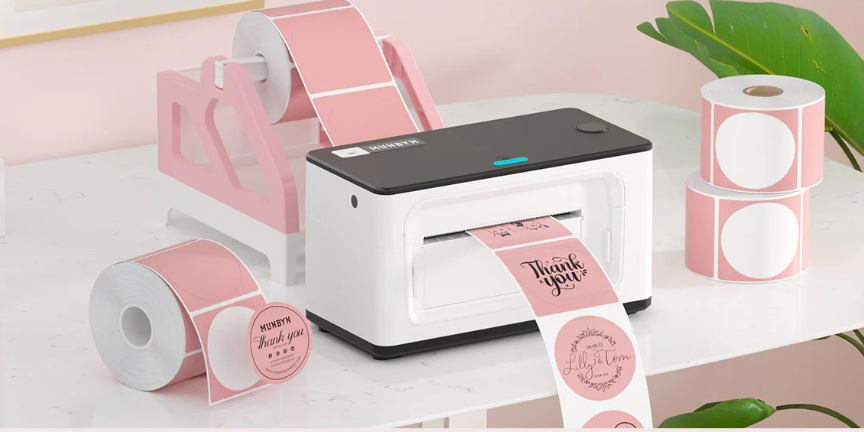
While standard circles and squares are classic options, die-cut stickers that follow the shape of your logo can provide a more exclusive look. If you're using a small business sticker printing device, make sure your design fits comfortably within the printable area of your labels. 1-inch round stickers are perfect for sealing tissue paper, while larger 3-inch labels work better as primary branding on the outside of a shipping box.
Here's an overview of popular options for small businesses:
|
Use Case |
Recommended Size |
Why It Works |
Label Example |
|
Product Packaging |
2" Circle or 2x2" |
Fits on jars, boxes, and thank you cards |
Round Labels |
|
Shipping & Branding |
4x6" or 4x3" |
Serves as address and logo sticker |
|
|
Inventory & Storage |
2.25x1.25" Rectangle |
Clearly legible on shelves or bags |
Rectangular Labels |
|
Promotional Gifts |
2" Round |
Ideal for laptops or cars |
Custom Stickers |

Essential Technical Tips for Sticker Design
Before you hit print, you need to ensure your digital files are properly prepared for physical production. A design that looks great on a vibrant smartphone screen doesn't necessarily translate perfectly to a physical label.
To achieve the best possible result, always create your stickers in high resolution, preferably 300 DPI (Dots per Inch). This prevents a "pixelated" or blurry appearance that could make a company look amateurish. Also, pay close attention to font selection. Your company name should be easily readable from a distance. Avoid overly fine fonts, as these can be difficult to read in small formats.
Understanding Color and Contrast
The way colors interact on a printed surface differs from their display in digital design tools. High contrast is your best friend when it comes to brand visibility.
In thermal printing, contrast is particularly crucial. Since most thermal printers use heat instead of ink, your design needs clearly defined lines and solid fills. If you want to add color accents, the MUNBYN RW405B offers unique two-color printing capability. This allows you to use special two-color stickers to highlight important parts of your logo—like a red heart "♥" or a blue accent "★"—making your brand instantly more recognizable than with standard black and white labels.
Step-by-Step Guide to Printing Company Logo Stickers
Once your design and printer are ready, it's time to bring your vision to life. A consistent process ensures that every batch looks as good as the first.
Follow these simple steps:
-
Export File: Save your design as a high-quality PDF or PNG.
-
Load Labels: Load your chosen thermal stickers into the printer, ensuring correct alignment.
-
Calibrate: Perform a quick calibration test so the printer recognizes the size and spacing between stickers.
-
Print Sample: Always print a single sticker first to check alignment and darkness settings.
-
Batch Print: Once satisfied, print the quantity needed for your inventory.
Creative Ways to Use Your New Stickers
Now that you have professional stickers, you should use them strategically. The more often your logo appears, the more familiar your brand will become to your customers.
Place your logo stickers on the following items:
☞ On the outside of shipping bags or boxes to build anticipation.
☞ On product packaging such as glass materials, plastic bags, or cardboard tubes.
☞ On thank you cards or packing slips for a personal touch.
☞ As free giveaways ("swag") that customers can stick on laptops or water bottles.
☞ As QR code labels that direct customers to your social media or a discount page.
Maintaining Your Equipment for Long-Term Success
To ensure your branding always looks precise, you need to maintain the equipment that produces it. Proper maintenance prevents printing errors and extends the lifespan of your hardware.
The most common problem with thermal printing is a dirty print head, which can cause white lines or faded areas on your stickers. Regular cleaning of the print head with an alcohol swab ensures that your small business sticker printing device runs smoothly. For the RW405B model, the replaceable print head is a significant advantage, as you can refresh the machine's performance after intensive use without having to buy an entirely new device.
Final Thoughts
Investing time in a sticker strategy is probably one of the most effective ways to enhance the professional image of your small business. From the initial design ideas to choosing a reliable printing solution for all MUNBYN printers—every step contributes to building a stronger brand identity.
Thanks to cutting-edge technology and extensive design libraries, anyone today—even without a design background—can achieve first-class results. Don't forget that your stickers are more than just paper with adhesive; they represent your brand's story and your pursuit of excellence. Use your customized logos as a seal of quality that encourages your customers to return. With the right strategy and tools, there are no limits to your brand's growth.
Share:
How to fix label printer alignment issues
How to Create a Dreamy Pink Office Setup on a Budget