



 France
 Bestseller
 All Printers
 All Labels
 Money Counters
 All Accessories
A Strategic Guide for Female Entrepreneurs Who Want to Combine Aesthetics and Productivity

In 2026, the concept of the home office has fundamentally changed. It is no longer just a place where work is done – rather, it is the space where products are packaged, content is created, and brand identity is expressed in its most tangible form. For many female entrepreneurs running Etsy shops, small e-commerce brands, or side projects, the workspace has become one of the most influential – and often most underestimated – factors for consistency and growth.
The trend toward the “Pink Aesthetic Office” reflects this development, but its significance goes far beyond mere optics. When implemented correctly, a pink-themed workspace is not about decoration, but about consciously creating an environment that reduces friction, maintains creative energy, and strengthens brand identity in every step of the workflow.
The real challenge lies not in inspiration, but in execution: How can an aesthetic, budget-friendly workspace be created that simultaneously meets the demands of a real business operation?
1. Aesthetics as Cognitive Infrastructure
In many discussions, aesthetics are considered a superficial factor. In reality, however, they function as a kind of cognitive infrastructure that directly influences how efficiently work is done – especially for repetitive, detail-oriented tasks like order fulfillment or label printing.
Why Visual Consistency Affects Performance
A visually inconsistent workspace – characterized by different devices, strong contrasts, and clutter – leads to subtle but continuous interruptions in concentration. These accumulate over time into mental fatigue, slowed work, and reduced consistency.
For small businesses that package orders or print shipping labels daily, this inefficiency quickly becomes a hidden cost factor.
The Functional Effect of Soft Pink Tones
Soft, coordinated color environments – especially with nuances like blush, rosé, or muted pink – reduce visual overstimulation without appearing monotonous. They create a sense of continuity that makes it easier to work focused for extended periods.
This is particularly crucial for solo entrepreneurs: productivity does not arise from short bursts of performance, but from continuous, repeatable processes. A well-thought-out pink office setup supports this consistency by reducing cognitive load.
2. The “Tech Anchor” Principle
The most common mistake when setting up an affordable workspace is to plan decoration around functional devices, rather than intentionally integrating them.
Many office devices – especially printers – are large, dark, and disrupt visual harmony. Therefore, many users try to hide them, which leads to a separation of aesthetics and function.
Design Your Workspace Around Your Most Important Tools
A more effective strategy is to start with a "tech anchor" – a central device that:
- is used regularly
- is visually present
- plays a key role in the workflow
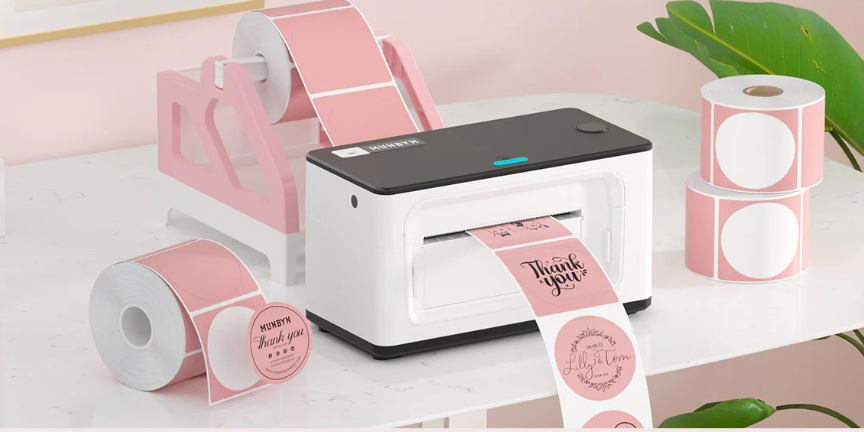
For e-commerce providers, this is usually the label printer. Instead of hiding it, it is deliberately integrated into the design concept.
This is where MUNBYN's system comes in. It was developed to make functional devices like thermal printers harmonious components of an aesthetic workspace. By visually coordinating your most important tools:
- you avoid visual breaks
- you reduce effort and adjustments
- you create a workspace that is automatically "content-ready"

3. High-Impact, Low-Budget Design Strategies
A high-quality, pink-themed workspace does not require completely new furniture. The key is to focus on high-impact, low-cost measures.
A. The Power of Visual Uniformity
Different materials and colors create what is called "visual noise." This increases cognitive load and makes even tidy workspaces appear restless.
A simple solution is to unify visible items. By painting or replacing small elements like pen holders, trays, or organizers in a consistent color palette, a harmonious overall look can be achieved with minimal effort.
B. Light as a Productivity Factor
Lighting is often underestimated as a decorative element, but it plays a central role in productivity and content creation.
- Warm ambient light reduces eye strain
- Rosy light tones enhance the atmosphere
- Even lighting improves the quality of photos and videos
For content creators and small businesses, the workspace becomes an optimal shooting environment without additional effort.
C. The Desk Mat as a Visual Base
Instead of replacing the entire desk, a large desk mat can redefine the entire work surface.
It:
- covers visual irregularities
- creates a clear, uniform surface
- improves the presentation of products in photos and videos
This is one of the most cost-effective ways to optimize aesthetics and functionality simultaneously.
4. From Order Fulfillment to Brand Experience
An often-underestimated aspect of a workspace is its influence on packaging. For many businesses, packaging is merely a logistical step – in reality, however, it is a central part of the customer experience.
Why Your Packaging Area Is Crucial
Customers experience your brand physically through packaging and digitally through content. A consistent workspace ensures that both experiences are consciously designed and coordinated.
From Workflow to Content
When tools, labels, and environment are visually harmonious, the packaging process itself becomes a repeatable source of content.
This is particularly relevant for:
- TikTok videos ("Pack an Order with Me")
- Instagram Reels
- Brand storytelling
The use of coordinated solutions – such as MUNBYN thermal printers and labels – helps to standardize efficiency and visual quality, transforming everyday processes into scalable marketing resources.
5. Creating a Sustainable Aesthetic System
A common mistake with pink workspace concepts is overloading with color, which can lead to visual fatigue in the long term.
The 60-30-10 Rule for Balance
To maintain a balance between aesthetics and functionality:
- 60% neutral: White, beige, or light wood colors for stability
- 30% primary pink: central elements like devices or desk mats
- 10% accents: metallic tones or plants for contrast
This structure ensures that your workspace:
- is visually appealing
- professional
- and remains comfortable to use in the long term
Conclusion: Aesthetics as a Growth Strategy
A stylish workspace is not just a design choice, but an entrepreneurial investment. A thoughtfully designed workspace:
- reduces cognitive load
- increases workflow efficiency
- strengthens brand perception
- supports consistent content creation
Over time, these benefits lead to measurable growth.
With thoughtful solutions from MUNBYN, a workspace that is both aesthetic and powerful is no longer a luxury – but the new standard. Your perfect pink workspace is closer than you think.
For a limited time, use discount code “MYSEO” and get an additional 8% discount on all MUNBYN products – and create a setup that is as efficient as it is inspiring.
Share:
Guide to Designing Logo Stickers for Small Businesses
9 Years of Innovation: Why Small Businesses Trust MUNBYN Label Printers