


 Netherlands
 Bestseller
 All Printers
 All Labels
 Money Counters
 All Accessories
Inkjet printers and thermal printers are among the most common printing technologies. Both systems use heat and pressure to print text, images, and graphics, but their operating principles differ significantly. In this article, we explain how both types of printers work to highlight the differences and help you make an informed decision about the right printer for your needs.
How Inkjet Printers Work
An inkjet printer stores ink in a cartridge filled with a sponge-like material. When a print job is initiated, ink is sprayed from the cartridge through tiny nozzles onto the paper. A heating element briefly heats the ink, causing small droplets of ink to land on the paper, creating the printed image. Each color is applied by a separate nozzle, and by combining different colors, various shades of gray or intermediate colors can be produced.

How Thermal Printers Work
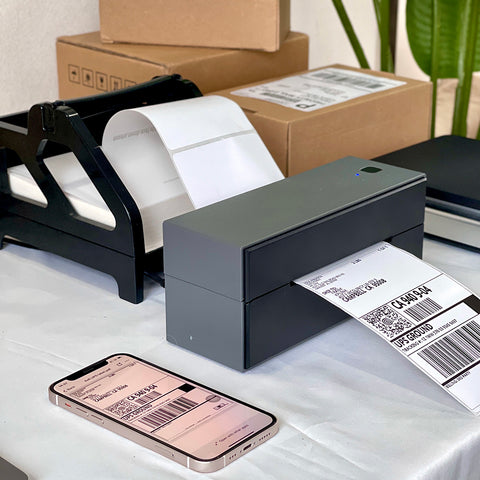
Thermal printers use heat to transfer color from a special ribbon to the paper. This ribbon is coated with carbon particles that appear black. When a sheet of paper is fed into the printer, the heat causes the particles to detach from the ribbon and adhere to the paper, resulting in the characteristic dark impressions.
Cost
The initial cost of a thermal printer is generally higher than that of an inkjet printer. The main reason is that thermal printers require special ribbons, which are more expensive compared to standard inkjet printer cartridges. Although the initial cost of ribbons is higher, they have the advantage of lasting up to ten years.
Print Quality
For quality and accuracy of text printing, thermal printers are the better choice. They produce crisp results with clear characters and lines, which is particularly beneficial when printing small font sizes or numbers.
Inkjet printers, on the other hand, are ideal for photo printing, as they produce high-resolution images with outstanding clarity and vibrant colors.
While thermal printers fall short of inkjet printers in terms of color reproduction, they are still capable of printing appealing graphics that are perfectly adequate for most business purposes.
Reliability and Durability
Thermal printers are characterized by higher reliability and durability compared to inkjet printers. Maintaining inkjet printers can be expensive, especially if print head problems occur. In contrast, thermal printers have lower maintenance costs and are considered more reliable.
Portability
As mentioned earlier, thermal printers are more portable than inkjet printers. This is because they are more compact and do not require heavy paper to print on. They can be easily carried in a backpack if you need to do your work on the go. If you want to print something small at home, such as receipts or price tags , a thermal printer is definitely more suitable due to its light weight and portability.
Use Cases
Next, you should consider whether you need a printer for personal use or for a small business. Inkjet printers are the most common type and are generally less expensive than thermal printers.
Currently, however, inkjet printers are not considered as fast and reliable as thermal printers, especially in terms of speed and print quality. If you need fast printing for your business and are willing to pay more for it, a thermal printer for shipping labels might be just the right choice!
Conclusion
When looking for a printer, you should consider which type is best suited for your requirements. If you are looking for something more portable or more affordable than an inkjet printer, a thermal printer might be worth considering. However, you should take the time to find out if it is suitable for your business needs!

Share:
Bluetooth Printer vs. Wi-Fi Printer
7 Ways to Use ChatGPT for Your Etsy Shop