




 France
 Bestseller
 All Printers
 All Labels
 Money counting machine
 All Accessories
Shipping costs are among the largest expenses for small businesses that sell physical products. Whether you sell on Etsy, run a small retail store, distribute home goods, or offer a subscription box – if you ship goods, you know how much shipping costs can impact your margins.
If you are looking for effective ways to sustainably reduce these costs, here is a comprehensive and practical guide. In this post, you will learn how to save money at various stages of the shipping process – from optimizing packaging to choosing the right shipping label printer.
Optimize dimensional weight
Many founders assume that shipping costs are based solely on the actual weight of a package. However, large shipping carriers like UPS, FedEx, or USPS often calculate what is known as dimensional weight (DIM Weight).
This calculation considers not only the weight but also the package volume. If you ship a very light item in an oversized box, you might be paying for the space occupied – not for the actual weight.
How to save money:
★ Downsize packaging: Always use the smallest possible packaging that still securely protects your product.
★ Use poly mailers: For non-fragile products like clothing, poly mailers are excellent. They are lighter, save space, and often qualify for cheaper shipping rates.
★ Custom packaging: For core products, investing in custom-sized boxes can be worthwhile to avoid unnecessary empty space.
Use shipping software for business rates
If you ship your packages at regular counter rates, you might be paying 30–40% more than necessary. Small businesses should generally use business rates.
Platforms like Pirate Ship, Shippo, as well as integrated shipping tools from Shopify or Etsy, provide access to "Commercial Base Pricing" rates. These providers bundle the shipping volume of many small businesses, thus negotiating attractive discounts with major shipping carriers.
Your advantages:
★ Access to exclusive special rates: Shipping options like USPS Parcel Select Ground and Priority Mail Cubic (where pricing is based on dimensions rather than weight) are often exclusively available through corresponding shipping software platforms.
★ Automation: These tools synchronize directly with your online shop and automatically import address data. This significantly reduces manual entry errors and saves valuable working time.
Invest in professional shipping label printers
In the initial phase, many businesses print shipping labels with a conventional inkjet printer, cut them out, and attach them with tape. This approach is practical for a few shipments but becomes inefficient and costly as order volumes grow.
The benefits of a shipping label printer for small businesses
Investing in a dedicated thermal printer often leads to a quick return on investment.
MUNBYN offers professional thermal printing solutions specifically for small businesses, home offices, and startups. Thermal printers operate without ink or toner – they produce the print image by applying heat to special label material.
Why this saves costs:
★ No ink or toner costs
★ High printing speed – labels are created in seconds
★ Professional appearance – standardized 4x6 inch labels facilitate scanning and reduce errors or surcharges
Use direct thermal labels to reduce material costs
In addition to hardware, consumables also play a central role. Direct thermal labels are considered the industry standard in e-commerce shipping.
By using high-quality MUNBYN thermal labels, you can efficiently streamline your shipping processes without having to invest in expensive, custom-printed boxes.

Practical savings potential:
★ No additional tape required – simply peel and stick
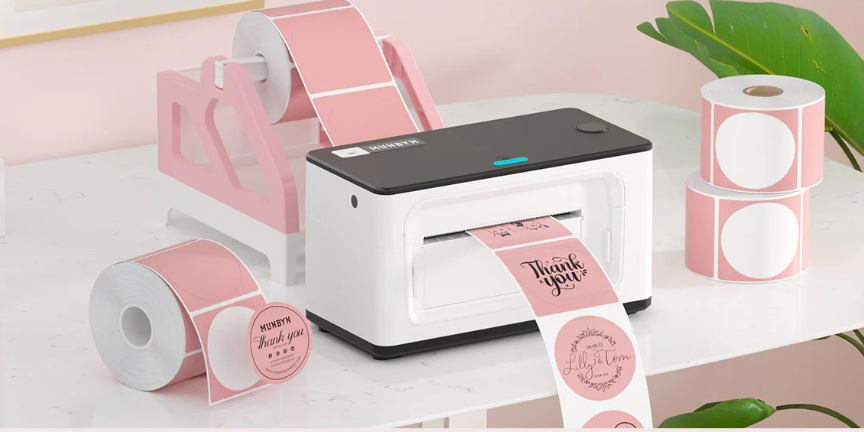
★ Cost-effective branding – colored or shaped labels allow for custom design with a logo or "Thank You" notes
★ High durability – water and oil-resistant labels prevent smudging or damage during transport
Actively negotiate shipping terms
Do not assume that published shipping prices are unchangeable. With a monthly shipping volume of 50–100 packages, you already have room for negotiation.
Recommended approach:
-
Contact a business account representative from UPS or FedEx.
-
Point to competitor offers and signal willingness to switch.
-
Focus on surcharges such as fuel or residential surcharges, which are often negotiable.
Review return policy
Shipping costs arise not only from shipping to customers but also from returns. An inefficient returns process can significantly burden margins.
How to reduce return costs:
★ Detailed product descriptions and high-quality images to manage expectations
★ Use digital return portals with business rates
★ For inexpensive products, consider offering a replacement without a return
Why MUNBYN is the right choice for growing businesses
Efficiency and professionalism are key success factors in the shipping process. MUNBYN develops solutions specifically for small and medium-sized businesses.
-
Versatility: MUNBYN thermal printers are compatible with common platforms like Shopify, eBay, Amazon, and Etsy, as well as with Windows and Mac systems.
-
Brand presence: In the age of "unboxing" experiences, packaging plays a central role. With different label colors and shapes, you can create a brand-consistent appearance – without high printing costs.
-
Sustainability: By eliminating ink cartridges, you reduce plastic waste. Precise label printing also minimizes paper waste due to misprints.

Conclusion
Switching to a professional thermal printing solution with MUNBYN printers and high-quality direct thermal labels often pays for itself within a few months – through saved ink and labor costs.
Shipping should not be a cost driver but a growth instrument. With the strategies presented, you secure your margins, improve the customer experience, and avoid unnecessary expenses in every shipping operation.
Are you ready to sustainably reduce your shipping costs?
Discover MUNBYN's comprehensive shipping solutions and take the next step towards a more efficient and profitable e-commerce business.
Share:
Valentine's Day Gift Ideas for Creative Women
4x6 Shipping Labels Explained: Why They Are the Industry Standard