




 France
 Bestseller
 All Printers
 All Labels
 Money counting machine
 All Accessories
Efficiency is the engine of success in the fast-paced world of e-commerce. From the moment a customer clicks "buy" until the product arrives at their home, numerous processes must seamlessly intertwine. At the heart of this logistical interplay is a small, often overlooked piece of adhesive paper: the 4x6 shipping label.
If you've ever received a package from Amazon, UPS, or an Etsy shop, you've likely encountered it. Measuring 4 inches × 6 inches, this specific shipping label format has become the undisputed standard in the logistics industry. But why? Why not 5×7 or 3×5? Why has the entire global supply chain settled on precisely these shipping label dimensions?
In this comprehensive guide, you'll learn why 4×6 is the industry standard, the business advantages of 4×6 shipping labels, and why MUNBYN thermal shipping labels are an excellent choice for businesses.
What does "shipping label size" actually mean?
When we talk about shipping label size or shipping label dimensions, we mean the physical measurements of a label affixed to a package for shipping. These measurements are important because shipping carriers like USPS, UPS, FedEx, DHL, and others have specific requirements for barcode placement, address readability, and scan reliability.
If a label is too small or incorrectly formatted, it can lead to delays, mis-scans, or even additional fees if the carrier's specifications are not met.
Among the many available formats, one size particularly stands out:
The standard for shipping labels is 4 inches wide and 6 inches high
(equivalent to 101.6 mm × 152.4 mm in the metric system).
This format has become the standard for e-commerce platforms and shipping software for good reason.
Why 4x6 is the industry standard
1. Universal Compatibility with Shipping Carriers
The most important reason for the success of the 4×6 format is its universal support by major logistics companies: USPS, FedEx, UPS, DHL, and Amazon.
Sorting centers use high-speed cameras and laser scanners specifically designed to recognize certain markings on packages. Since 4×6 is the standard shipping label format, these systems are optimized to quickly and reliably recognize and process this exact size.
If you use a non-standard format, there is a risk that your package may need to be processed manually, which can lead to delays or additional costs.
2. The Rise of Thermal Printing Technology
Before the e-commerce boom, many small businesses printed their shipping labels on conventional A4 or Letter paper (8.5 × 11 inches), cut them out with scissors, and then taped them to packages. This process was time-consuming, expensive (due to ink or toner costs), and unprofessional.
The introduction of direct thermal printers fundamentally changed this. These printers require no ink or toner. Instead, heat creates an image on specially coated paper.
The 4×6 format became the standard for thermal printers because it offers the optimal compromise between size, readability, and printer compactness. A 4-inch print head is small enough for a desktop printer but wide enough for high-resolution barcodes.
3. Fewer Errors and Better Scannability
In logistics, an unreadable barcode ("no-read") is a serious problem. If a barcode is printed too small or out of focus, the automatic sorting system cannot process the package correctly. The 4×6 shipping label dimensions allow for: large, highly visible barcodes, high contrast, reliable scannability.
Even if the label is slightly creased or covered by clear tape, the barcode usually remains easily readable.
4. Cost-Effectiveness
Since 4×6 is the most commonly produced shipping label format worldwide, classic economies of scale apply here.
Manufacturers can produce these labels in huge quantities, significantly reducing the price per label.
For high-volume shippers, saving just a few cents per label can amount to several thousand dollars annually.
The advantages of 4x6 labels for your business
Transitioning to a dedicated 4×6 thermal label workflow is often the first truly professional step for growing e-commerce businesses.
Professional Appearance and Brand Trust
The first impression counts. A package with a cleanly printed, perfectly aligned 4×6 label looks significantly more professional than a package with a hand-taped piece of printer paper.
It signals to your customers that you are a serious business with an efficient shipping process.
Faster Order Fulfillment
4×6 labels on rolls or in fanfold stacks allow you to print and apply labels in seconds.
Combined with platforms like Shopify, eBay, or Etsy, you can print dozens of shipping labels with just one click. No scissors. No tape. No fuss.
High Durability
Most 4×6 thermal labels, such as MUNBYN Thermal Shipping Labels, are designed to be: scratch-resistant, waterproof, oil-resistant.
Since the "ink" is actually a thermal reaction in the paper, there's no wet ink to smudge if a package, for example, sits in the rain on a customer's porch.

What makes MUNBYN shipping labels special
Even though 4×6 is the industry standard, that doesn't mean your shipping labels have to be boring. As e-commerce competition intensifies, the "unboxing experience" has become a vital part of brand strategy.
MUNBYN offers 4×6 shipping labels in various colors and designs.
Why stick with classic white when you can also use these options?
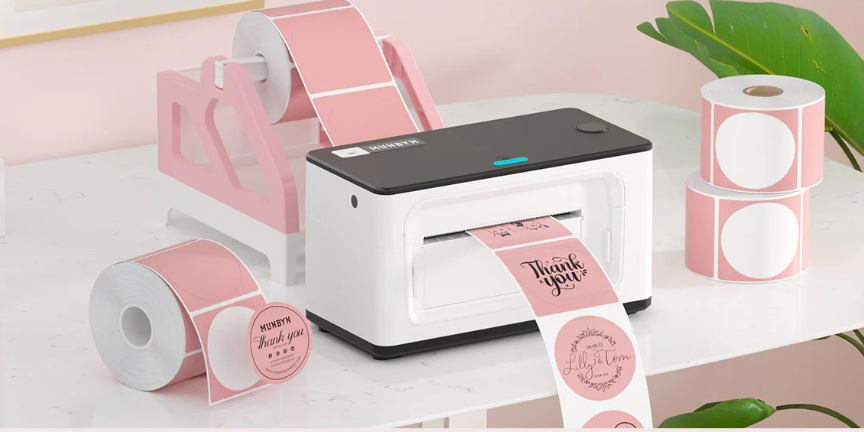
★ Colored Labels: Pink, blue, or kraft paper brown, matching your brand's aesthetic.
☛ Choose pink or blue labels if: You use colorful packaging. You want to reflect your brand's design style.
☛ Choose kraft paper brown labels if: You want to convey a sustainable brand image. You prefer a simple and elegant style.
With colored 4×6 labels, you maintain the standard dimensions required by the shipping carrier while giving your brand a unique personality that sets you apart from the competition.

Not just a 4x6 label for your package
The 4×6 shipping label primarily serves to display all important information in the logistics process. However, this does not mean that you are only allowed to stick a single label on your package.
As long as the readability and content of the shipping label are not impaired, additional labels or stickers can be used as decorative elements.
In addition to thermal shipping labels, MUNBYN also offers many other sticker sizes and creative labeling solutions. Let your creativity run wild and customize your packaging.
Conclusion
A 4×6 shipping label is much more than just a piece of paper. It is a global standard that makes modern online retail efficient in the first place.
By using these exact shipping label dimensions, businesses can: ensure full compatibility with major shipping carriers, significantly reduce shipping errors, provide a professional experience to their customers.
Whether you are just shipping your first order or sending thousands of packages daily – the 4×6 format is your reliable partner.
And with MUNBYN's high-quality and creative options, you can ensure that your "standard labels" are anything but ordinary.
Say goodbye to ink cartridges and tape rolls. Use the shipping label format that the professionals use – and transform your shipping process from a bottleneck into a real competitive advantage.
FAQs
Q1: Can I use a different size for shipping labels?
Technically, yes. Some shipping carriers offer, for example, 8.5×11 "half-page labels". However, these are often more expensive per label and require more storage space. For international shipping, the 4×6 size is preferred almost everywhere.
Q2: Do I need a special computer for 4×6 printing?
No. Most MUNBYN thermal printers connect via USB or Bluetooth and work with both Windows and Mac. You can easily print shipping labels with smartphones, tablets, or computers.
Q3: Are thermal labels environmentally friendly?
This is an important aspect. Some older thermal labels contained BPA. However, MUNBYN offers BPA-free and BPS-free labels that are safer for both your employees and the environment.
The use of such labels can also help to strengthen the environmentally conscious image of your brand.
Share:
How Small Businesses Can Reduce Shipping Costs
Eco-Friendly Packaging Ideas for Small Businesses